
Most basements in Towson and Catonsville start the same way: block walls, a furnace in one corner, and a homeowner picturing a family room or a guest suite. The order you plan in decides how that turns out. Get the sequence wrong and you end up paying to tear out new drywall. Here's how we'd work through it, from the first moisture check to the signed contract. If you want to see the kind of work involved first, our basement finishing page walks through it.
Start With Water Before Floor Plans
Walk the basement after a hard rain. Look for white chalky deposits on the block, damp spots where the floor meets the wall, and that musty smell that never quite leaves. Then go outside and see where your downspouts empty and which way the yard slopes. Water that runs toward the foundation will find its way in eventually.
Any leak gets solved before framing starts. Insulation and drywall set against a wet wall hold that moisture where nobody can see it, and you'll find out a year later. Waterproofing appears on the state's list of work that usually requires a Maryland Home Improvement Commission license, right alongside drywall, insulation and ceilings. So the crew sealing your walls should be licensed just like the crew finishing them.
Planning a project like this? Call Top Notch Contractors at 410-598-9933 for a straight estimate. We're a licensed Maryland home-improvement contractor (MHIC# 05-147079) remodeling Baltimore homes since 2010.
Building a Budget You Can Defend
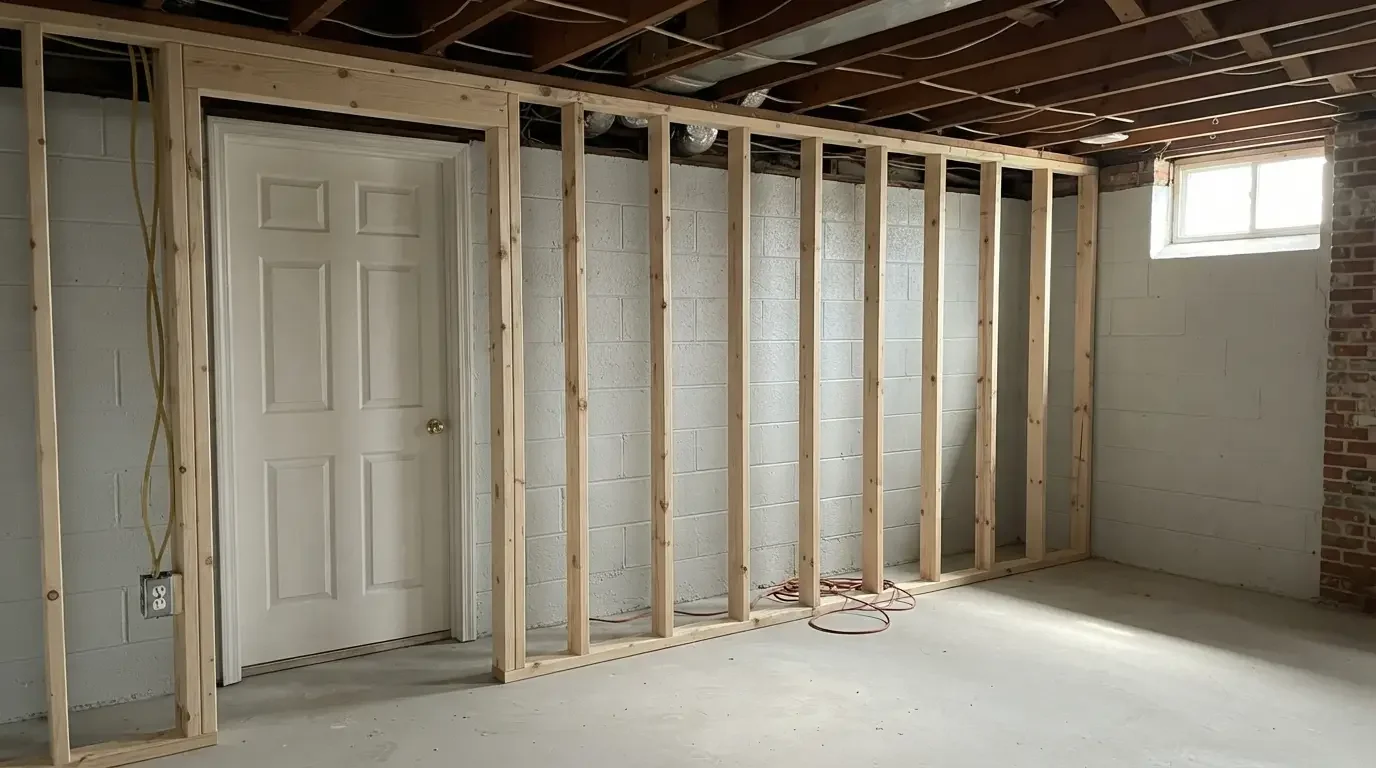
A basement price swings on a handful of decisions. Adding a bathroom brings plumbing into the job, and depending on where your main drain sits, the fixtures may need a pump to lift waste up to it. A bedroom means thinking about an escape window, and cutting a new opening in a foundation wall is one of the bigger single items on any basement estimate. Low ductwork and beams decide whether you get a flat drywall ceiling or soffits boxing them in.
Get several written estimates on the same written scope so you're comparing like with like. Hold back a contingency for what turns up once walls open in an older house.
Maryland gives you some protection on the money side. A contractor can't take any payment until the contract is signed, and the deposit can't be more than one third of the contract price. Past that deposit, the payment schedule is open to negotiation, so tie the remaining draws to work you can see: framing done and inspected, drywall hung, final inspection passed. If you're financing the project with a loan secured by your house, the contract has to carry a notice on its first page, and you get three business days after signing to cancel in writing.
Layout Choices That Move the Price
Plan around the mechanicals rather than hiding them. The furnace, water heater and panel need clear access for service, so they usually end up in an unfinished utility room with a real door. That room is also the cheapest storage space you'll ever build.
Decide early whether any room will be used as a bedroom, and ask your contractor what that would take at your house before the drawings are done. It's far cheaper to plan an escape window than to add one later. For floors, pick something that tolerates the occasional damp day better than solid hardwood would.
Permits for Towson and Catonsville Homes
Towson and Catonsville both sit in Baltimore County, so you'll be dealing with the county, not Baltimore City. A basement finish usually touches framing, electrical and sometimes plumbing in one job, so ask every bidder the same three things in writing. Which permits will they pull for your scope? Who applies and who meets the inspectors? Is the permit fee already in the number?
If your house was built before 1978, there's one more check. Anyone doing renovation work that disturbs lead-based paint in a pre-1978 home needs EPA certification and has to follow lead-safe work practices, and the rule covers jobs that affect as little as six square feet of interior space. Painted basement walls and old trim count.
Choosing a Licensed Basement Contractor
Start with the license. Maryland requires contractors to show their MHIC number on contracts, trucks and advertisements, and the contract itself has to list the contractor's name, address and license number. Look the number up yourself; our guide to verifying an MHIC license shows how. The license matters if the job goes wrong, because the MHIC Guaranty Fund only covers work by licensed contractors, and a homeowner can recover up to $30,000 through it. Contractors also have to carry general liability insurance of at least $500,000, so ask for the certificate.
Then read the contract closely. It has to be in writing and signed by both of you, and it has to describe the work and the materials. It must give approximate dates for when work begins and when it will be substantially complete, and you should have a signed copy before anyone starts. If there's an arbitration clause, both of you initial and date it. Anything vague gets rewritten before you sign.
We work across the county, from Towson to Catonsville.
For an estimate on your own project, call 410-598-9933. Top Notch Contractors is MHIC-licensed (#05-147079) and has been remodeling Baltimore homes since 2010.