The Baltimore area sees an average of eight freeze-thaw cycles per year. That means eight times every winter, water seeps into the ground, freezes, expands with incredible force, and then thaws, letting everything settle back down. For a poorly built patio, that cycle is a death sentence, causing stones to heave, pavers to shift, and joints to crack. The difference between an outdoor living space that lasts three years and one that lasts thirty isn't the material you see on top; it's the six inches of compacted base underneath that you don't.
At Top-Notch Contractors, we've built over 500 outdoor projects since 2010, and every one starts with a free in-home consultation where our founder, Dominic, assesses your specific site conditions. We provide a fixed-price quote that accounts for the realities of Maryland's climate. Call us at (410) 598-9933 to schedule yours.
The Foundation: Why Drainage and Base Prep Are 90% of the Job
Homeowners in Towson and Lutherville often focus on the surface material, like bluestone or pavers. But a project's long life is decided before we lay any stone. A strong, well-drained sub-base is what matters. Much of Baltimore County has heavy clay soil. It holds water and expands a lot when it freezes. A simple 2-inch sand base, which some contractors might try to get away with, is completely inadequate here. It will fail, guaranteed, by the second winter.
Our standard process involves excavating 8 to 10 inches of soil. We then lay down a geotextile fabric to separate the native soil from our base material, preventing the clay from working its way up. On top of that, we install and compact a minimum of 6 inches of dense grade aggregate (also called crusher run). This is done in 2-inch "lifts," with each layer being mechanically compacted to over 95% proctor density. This creates a stable, porous foundation that allows water to drain away freely instead of collecting under the patio. Every patio also gets a subtle slope, usually 1/4 inch per foot. This sends surface water away from your home's foundation. This isn't the prettiest part of the job, but it's the most important.
Patio Materials That Survive Maryland Winters: Pavers vs. Natural Stone
With a proper base in place, you can choose a surface material that fits your home's aesthetic and budget. The two primary choices are interlocking concrete pavers and natural stone. In neighborhoods like Roland Park, with its historic homes, natural stone like Pennsylvania Bluestone is often preferred for its timeless look. You've got to pick a good, low-absorption stone. Cheaper kinds can flake or chip after many freeze-thaw cycles. For projects in historic districts, CHAP (Commission for Historical and Architectural Preservation) might need to review your material choice. We can help with that process.
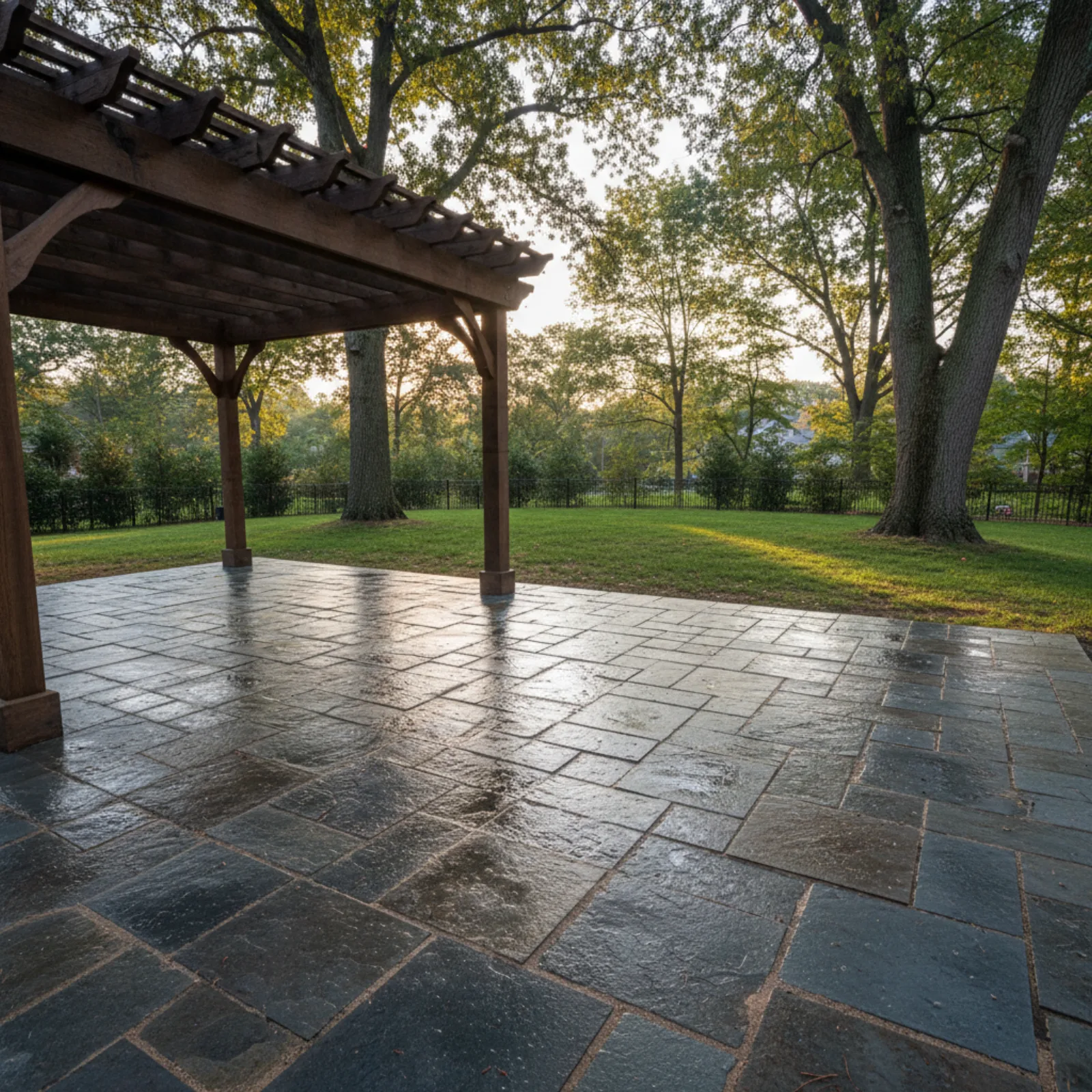
Concrete pavers from manufacturers like Techo-Bloc or EP Henry offer a more uniform and often more affordable alternative. They are engineered with low water absorption rates and high compressive strength, making them extremely resistant to cracking and salt damage. Their interlocking design adds strength to the entire surface. For the 1950s-era homes common in Catonsville, a classic paver pattern can perfectly complement the architecture. The main trade-off is aesthetics; while modern pavers have come a long way, some homeowners still prefer the unique character and color variation of natural stone.
Pergolas: Wood vs. Composite vs. Vinyl in Mid-Atlantic Humidity
A pergola defines an outdoor room, but Baltimore's summer humidity is brutal on building materials. Material choice is everything. Pressure-treated pine is the most common and budget-friendly option, but it demands regular maintenance. It must be sealed or stained every 2-3 years to prevent rot, warping, and insect damage. Cedar is a step up, offering natural resistance to rot and insects, but it comes at a higher price point and still requires periodic sealing to maintain its color. For a truly long-lasting wood structure, especially in waterfront spots like Severna Park, tropical hardwoods like Ipe are the toughest. But they cost a lot.
For homeowners who want to eliminate maintenance, composite and vinyl are excellent alternatives. A vinyl (PVC) pergola will never rot, warp, or need painting, requiring only occasional cleaning. Composites, made from a mix of wood fibers and plastic, offer a similar low-maintenance profile with a look that can more closely mimic real wood. These materials are impervious to the moisture and humidity that plague wood structures in our climate. While the upfront cost is higher than pressure-treated pine, the total cost of ownership over 15 years is often lower once you factor in the time and expense of repeated staining and sealing.
The Pergola Roof: Fixed, Louvered, or Retractable?
The function of your pergola is largely defined by its roof. The simplest option is traditional wood slats or purlins, which provide partial shade but no rain protection. A more functional choice for extending usability is a fixed roof using polycarbonate panels. These panels block UV rays and keep the space dry during a spring shower while still allowing natural light to filter through.
For ultimate control, motorized louvered roof systems are the premium choice. With the touch of a button, you can adjust the louvers from fully open (maximum sun) to partially angled (shade) to fully closed, creating a waterproof roof. This makes your pergola a true three-season room. A retractable fabric canopy offers a compromise. It provides excellent sun and rain protection when extended but can be retracted to enjoy an open sky. The fabric itself typically needs to be replaced every 8-10 years, making it a recurring maintenance cost to consider. The right choice depends entirely on how you plan to use your outdoor living space.
The Real Cost Breakdown for Baltimore Patios and Pergolas
Here are the typical cost ranges for professionally installed outdoor living projects in the Baltimore area. These are all-in prices, including proper base preparation, materials, and labor.
- Patio Base Prep & Installation Labor: $18 - $25 per square foot. This is the non-negotiable foundation of the project.
- Patio Surface Materials (Material Cost Only):
- Concrete Pavers: $6 - $12 per square foot.
- Pennsylvania Bluestone / Natural Stone: $12 - $22 per square foot.
- Total Patio Cost (400 sq. ft.):
- With Pavers: $9,600 - $14,800
- With Bluestone: $12,000 - $18,800
- Pergola (12'x12' Freestanding):
- Pressure-Treated Pine: $7,000 - $12,000
- Cedar or Composite/Vinyl: $12,000 - $20,000
- Motorized Louvered Roof System: Add $15,000 - $25,000 to the structure cost.
A complete project, such as a 400-square-foot paver patio with a 12'x12' cedar pergola in a Towson backyard, typically falls in the $21,000 to $35,000 range.
When a Full Outdoor Living Project Isn't the Right Call
A beautiful patio or pergola isn't the right solution for every backyard. We believe in being honest about a project's viability, and sometimes we advise clients to wait or address other issues first.
- Severe Drainage or Grading Issues: If your yard already has standing water after a moderate rain, laying an impervious patio surface can make the problem worse. The core issue. Be it grading, downspout management, or the need for a French drain. Must be solved first.
- Unstable or Immature Trees: Building a patio over the critical root zone of a large, old tree can damage or even kill it. If a massive oak is the centerpiece of your yard, the patio design must respect it, which can significantly increase complexity and cost.
- Budget Mismatched with Expectations: Investing in premium materials like thermal bluestone or a motorized pergola roof is pointless if the budget doesn't also allow for the proper foundational work. A well-installed paver patio will always outperform and outlast a high-end stone patio built on a shoddy base. It's better to scale back the material than to cut corners on the installation.
Get a Fixed-Price Quote for Your Project in Towson or Severna Park
With over 15 years of experience and as a fully licensed contractor (MHIC# 05-147079), we've seen what works and what doesn't in the Maryland climate. We're a field-based company without an expensive showroom, so our focus is entirely on quality craftsmanship and durable materials. Whether you're in a classic colonial in Towson, a split-level in Catonsville, or have a waterfront view in Severna Park, good construction rules stay the same.
Our process starts with a free in-home consultation to assess your property and discuss your goals. After that meeting, we'll give you a detailed, fixed-price quote. No surprises. Call Top-Notch Contractors today at (410) 598-9933 or fill out the form on our contact page to schedule your free consultation.
How long does a typical patio installation take in the Baltimore area?
For a standard 300-500 square foot patio, the entire process from excavation to final cleanup typically takes 5 to 10 working days. The timeline can be affected by weather, site access, and the complexity of the design or material choice.
Do I need a permit for a patio or pergola in Baltimore County?
Generally, on-grade patios do not require a permit. However, pergolas and other overhead structures often do, especially if they are attached to the house or exceed a certain size. We handle the entire permitting process as part of our service.
What's the best way to clean a bluestone patio to prevent winter damage?
Never use rock salt (sodium chloride) on bluestone, as it can cause the surface to pit and spall. Use calcium chloride or magnesium chloride de-icers instead, and always use a plastic shovel for snow removal. A thorough cleaning with a pH-neutral stone cleaner in the fall also helps prevent organic matter from trapping moisture.
How much maintenance does a wood pergola require in Maryland?
A pressure-treated pine or cedar pergola will require cleaning and re-sealing or staining every 2 to 3 years to protect it from moisture and UV damage. The intense summer humidity in Maryland makes this maintenance critical to prevent rot and decay.